Arcade
10 min readThe best browser games with leaderboards
Ten free browser games with real leaderboards, each with its scoring rules published: what a good run looks like, and what a perfect one would score.
Written by Bounty Board Team
Bounty Board editorial team
- browser games
- leaderboards
- arcade
A browser game you can finish in five minutes has one problem: nothing makes you open it twice.
A leaderboard fixes that with three things. A target, which is a number you can see. A rival, who is whoever sits one row above you. And a reason to replay, because your last run just became a fact you can beat.
That is the difference between "I tried it" and "I am 400 points short." The games below are the ones in the Bounty Board Arcade where that loop is sharpest and the scoring rules are published plainly, so you know what you are chasing before you start. All are free and run in the browser with no download.
The direct answer
Ten free browser games with leaderboards worth chasing:
- Flappy Sharkini, one tap flying with a published perfect score nobody has hit.
- Slop Stack Tower, one tap stacking where every sloppy drop shrinks your future.
- Geometry Slop Dash, one button running scored by distance.
- Slop Ninja Slicer, swipe slicing where multi cuts pay double.
- Linguini Snake, snake with a multiplier and five rule sets.
- Galaxy Brain Invaders, a wave shooter that rations your ammo.
- Gnocchi Asteroids, drift shooting where smaller targets pay more.
- Meatball Minesweeper, minesweeper with a speed bonus that drains while you think.
- Slop Head Football, sixty second matches scored on goals and clean sheets.
- Vectonova, cannon launched distance flying with a daily challenge.
Log in before you play and every run posts to that game's leaderboard automatically. Your best run is the one that counts.
Why a leaderboard changes a short game
The research is more mixed than the marketing usually admits, and the honest version is more useful.
In Designing Leaderboards for Gamification, a CHI 2017 paper, Jia, Liu, Yu, and Voida note that leaderboards motivate through social comparison, but that studies have found they motivate only some users and demotivate others. The same paper cites Butler's finding that players were more likely to replay when they landed at the top or the bottom of a board. The middle is the least interesting place to be.
The other half of the effect is fairness. A board only means something if everyone ran the same course. Spelunky's Daily Challenge is the clean example, and its official page is blunt about why: you get "one chance" each day, and "since everyone plays the same adventure during the Daily, you'll be able to know for certain who's the top Spelunky player." Writing for Game Developer in 2013, Mike Rose said the mode turned a very single player experience into "one of the most exciting multiplayer games I've ever taken part in".
That is why most games below ship a daily mode built from the date, identical for everybody playing that day. It also suits browser habits: Poki's 2026 State of Web Gaming Report, a survey of 2,000 web gamers and 400 developers in the US and UK, found the most common session is 11 to 20 minutes.
1. Flappy Sharkini
Flappy Sharkini is one tap, gravity, green pipes, and a gap the game describes as looking generous right up until you are inside it.
The chase is unusually legible. A perfect run of 500 pipes scores exactly 50,000 points, and the page states plainly that nobody has ever done it. A grade ladder from Bronze to Platinum tells you which band you are stuck in. Beyond the endless run there is a daily with the same pipes for everyone, plus live 1v1 rooms on an identical layout.
2. Slop Stack Tower
Slop Stack Tower is a sliding lasagna slab, one tap to drop it, and whatever hangs over the edge is sliced off forever.
The scoring panel is the whole strategy. A layer pays 100 and a perfectly centered drop pays 150, which more than doubles the layer while keeping the tower wide enough to continue. Sloppy drops cost you points now and width later. At layer 200 the tower is complete, and a run with no sheared slab scores exactly 50,000.
3. Geometry Slop Dash
Geometry Slop Dash is one button. Tap to jump, hold to keep bouncing the instant you land, and touching an obstacle sends you back to the beginning.
Ten points per meter plus 150 per espresso bean, ceiling 100,000, so distance is the score and the beans are the tax on greed. The telling detail is the practice mode: checkpoints every 200 meters and scores that are never saved, so you can drill a section without touching the board.
4. Slop Ninja Slicer
In Slop Ninja Slicer you drag to slice a flying roster of mascots. Three or more in one swipe pays double, and slicing the pink CRINGE ends the run.
That is the tension in a sentence: waiting for a group is worth twice as much and doubles your odds of catching the thing you should have let fall. A 60 second arcade mode softens it, docking 100 points for a CRINGE instead of ending the run, and the daily gives everyone the same characters in the same order.
5. Linguini Snake
Linguini Snake is snake, but the multiplier does the work.
A bite pays 50 times your current fry tier. Every fifth bite brews an espresso that sits on a fuse and pays 150 times your tier, up to 75, for no growth at all, and it goes cold if you dawdle. So the scoring line is not "eat everything," it is "raise the tier, then be somewhere useful when the espresso lands." Four board sizes, three speeds, and five rule sets, one of which sets a mirror twin walking your exact reflection.
6. Galaxy Brain Invaders
Galaxy Brain Invaders is a wave shooter whose real constraint is ammunition. Two shots in the air at a time, and a missed shot travels the whole field before you get it back.
That inverts the usual instinct: close accurate fire recycles the cannon, and spray does not exist. Enemies pay double while entering or attacking, skulls take two hits, and a tractor beam can steal your ride. Extra lives arrive at 20,000 and every 70,000 after, and the daily gives everyone the same trains, dives, and beam runs.
7. Gnocchi Asteroids
Gnocchi Asteroids is drift, thrust, and shoot, with a scoring table that punishes the safe option.
A large target pays 20 and splits in two. Its crumbs pay 50, then 100, and clearing one whole family is 520. The points are in the cleanup, which is also the part of the screen most likely to kill you. Ramming works and costs a life, delivery drones shoot back, and an extra ship arrives every 2,000 points.
8. Meatball Minesweeper
Meatball Minesweeper is minesweeper on a 16 by 16 grid with 40 mines, scored so hesitation is expensive.
Safe cells pay 100 each, clearing the field pays 15,000, and a speed bonus worth up to 10,000 drains at 100 points per second while you sit there thinking. A flawless instant sweep is 46,600, and one wrong cell ends the run. Its daily is the strictest board here: one field for everybody, and only your first finished attempt counts.
9. Slop Head Football
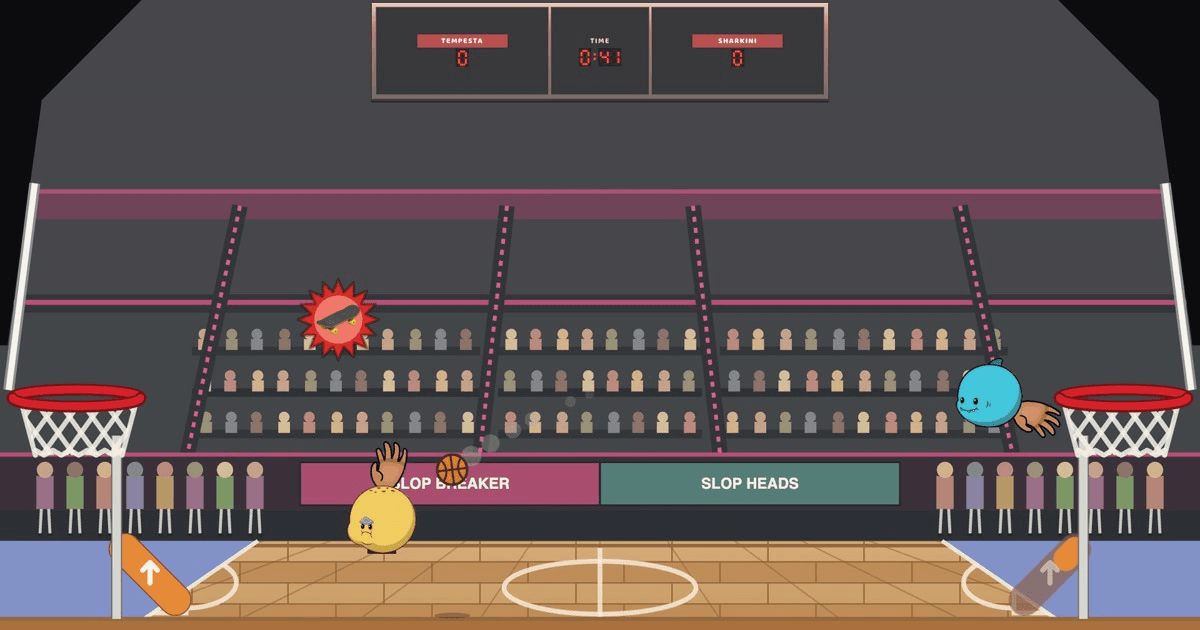
Slop Head Football is sixty second matches, two big heads, one small ball, and floating bars the ball caroms off that reshuffle after every goal.
Scoring rewards the win, not the highlight reel: every goal is 1,500, winning adds 3,000, and a clean sheet adds another 1,500. The Slop Cup ceiling is 36,000, a twenty one goal clean sheet rout. It also makes the clearest statement of leaderboard integrity in the Arcade: only solo matches against the CPU count, because "a score you can arrange with a friend is not a real score."
10. Vectonova
Vectonova launches you out of a cannon to fly as far as you can. Tap to launch, hold to boost, release to fall.
It is the outlier here. There is no published maximum score, because a run is distance and combos rather than a finite board, so the leaderboard is the only thing telling you what a good flight looks like. You upgrade the cannon, armor, and battery between runs, and there are daily challenges alongside a world ranking.
How leaderboards work on the Arcade
The mechanics are the same on every game page.
- Free, in the browser, no downloads. Games run on desktop, and most also run on mobile and tablet browsers.
- No account needed to play. Open any game and start immediately.
- But guests are not scored. The page says it plainly: playing as a guest, your scores are not saved. Log in first and every run posts automatically, with no submit step to remember.
- Your best run counts. Grinding attempts does not flood the board, it only raises your own entry.
- Two boards per game. Each page carries a high scores panel with a Today tab and an all time tab, so a bad month does not lock you out of today.
- Records are public, sitting on the game page alongside the max score where the studio published one. Once a game has had two records, its page lists up to the last ten on desktop, each with the date, the holder and the score, and the current holder can put a record badge on a website or share it as an image.
Not every title is scored. Games send scores through the Arcade SDK, and games that do not use it have no scoring panel, so if you are hunting boards, look for the "how this game scores" block on the page.
What this list is not
The Arcade is young and small. As of October 18, 2026 it lists 72 titles, up from 24 in August, still a fraction of what Poki or CrazyGames carries.
For a score chaser that cuts both ways. The boards are shallow, so a top spot is genuinely winnable this week and nobody is defending a five year record. You also will not find a large portal's depth of field.
Two more honest notes. Most of the deepest score chases here come from one studio, Slop Shop, which is why nine of the ten entries share a house style. And some scored games, including Birdy Blast and Slop Head Basketball, carry a board without publishing their scoring rules, so you learn a good run from the board rather than the page.
Start with the daily
If you only do one thing, pick a game above and play its daily. Everyone gets the same layout that day, which makes the number next to your name mean something specific.
Browse the full catalog in the Arcade, or start with what people keep replaying on popular browser games. If you make browser games, the Arcade takes game submissions, and we have written about what makes a browser game Arcade ready and why we built the Arcade.
Sources worth reading
Keep going
Ready to try something new?
Jump into the Arcade and see what indie teams are putting in front of players.
Related guides

Arcade
Why Bounty Board Arcade Exists
Bounty Board Arcade is built around a simple idea: discovery works better when players can try the game before reading the pitch.
- Published
- July 11, 2026
- Read time
- 4 min read
Arcade
Best free indie browser games you can play with no download
Ten games from the Bounty Board Arcade catalog, picked across genres. Each one is a click away, with no launcher, no install, and no account needed to start.
- Updated
- October 18, 2026
- Read time
- 10 min read
Arcade
New indie browser games worth discovering: August 2026
Nine browser games that are new or newly notable this month, described from their own pages, with the reason each one earned a slot stated plainly.
- Published
- August 19, 2026
- Read time
- 10 min read