Creator Opportunities
9 min readHow much can small gaming creators earn from sponsorships?
Sponsorship income is uneven. Here is what changes the rate, what comes out of the payment, and what one Bounty Board creator earned.
Written by Sean van den Broek
Marketing Lead, Bounty Board
- creator earnings
- gaming sponsorships
- paid creator work
- gaming creators
Small gaming creators can earn real cash before they have a huge audience. What they usually cannot count on is a reliable sponsorship salary.
One deal may pay $50. Another may pay a few hundred dollars because it asks for a longer video, more production, or broader usage rights. Then a month may pass with no deal at all.
That unevenness is the honest starting point.
The direct answer
There is no trustworthy monthly earnings number for small gaming creators. Sponsorship pay changes with normal views or live viewers, audience fit, format, workload, rights, and whether the deal pays a flat fee or only a commission.
There is no platform-wide definition of “small,” either. The YouTube benchmark below starts at 10,000 subscribers; the Lunari example is here because its reward record is public, not as an audience-size benchmark.
Two current reference points show why the answer needs labels:
- When checked on August 18, 2026, SponsorRadar modeled gaming YouTube sponsorships at $10 to $25 per 1,000 average views. In its 10,000 to 50,000 subscriber band, the median sponsored video had 2,898 views, which produces an estimated $29 to $72 deal value. Those are modeled ranges, not confirmed payments.
- Bounty Board's LunariValkyrie case study records $450 in completed campaign rewards across five campaigns and four indie games. Four rewards were $50 and one was $250, so the median was $50 and the average was $90 per campaign.
The first number estimates one type of YouTube integration. The second records one creator's paid campaign history. Neither is a universal rate, and neither tells you what every small creator will earn next month.
Four numbers that get confused
Before comparing yourself with another creator, check which number you are looking at.
1. Asking rate
This is the price on a media kit or in a quote. It is not proof that a deal closed at that amount.
2. Gross campaign reward
This is the agreed payment before platform fees, payment costs, and taxes. It is the cleanest number for comparing the work in two offers.
3. Cash received
This is what reaches the creator after any platform fee. Taxes and production costs may still come out later.
4. Total creator income
This can combine sponsorships, platform ads, subscriptions, donations, affiliate commissions, game sales, and other work. A headline about what a gaming creator “makes” may include all of them.
For Bounty Board work, the current standard creator fee is 10% on completed work, and limited promotions can lower it. Payment is sent to the creator's Stripe account when the studio approves the work. Stripe then holds the payout for seven days for dispute resolution. The current fee and payout details are in the FAQ.
That is why a campaign's public reward should not automatically be described as take-home pay.
What one gaming creator earned
The LunariValkyrie case study shows what this looked like for one creator across five completed campaigns.
Between November 9, 2025, and January 4, 2026, Lunari completed five paid campaigns across four games:
Completed campaigns
5
- Public reward amounts
- $50, $50, $50, $250, $50
- Total gross rewards
- $450
| Completed campaigns | Public reward amounts | Total gross rewards |
|---|---|---|
| 5 | $50, $50, $50, $250, $50 | $450 |
The case study also records 12 public deliverables, more than six hours of streamed gameplay, roughly 12,000 stream views, and repeat work. The reward history shows why an average can mislead: one $250 campaign pulls the $90 mean above the $50 median.
This is one creator's Bounty Board history over roughly eight weeks. It is not a claim that $90 is the normal campaign rate, that another creator will book five campaigns, or that every $50 reward is worth accepting. The useful proof is simpler: a gaming creator completed paid work, built a public record, and earned repeat bookings.
What a wider gaming estimate tells us
SponsorRadar's gaming benchmark uses view counts from 164,963 sponsored gaming videos tracked over the previous 12 months. It applies a $10–$25 sponsorship CPM to the median views in each channel-size band.
For channels with 10,000–50,000 subscribers, that calculation currently looks like this:
2,898 median views ÷ 1,000 × $10–$25 = about $29–$72
SponsorRadar is clear that these are estimates, not confirmed deal payments. The table starts at 10,000 subscribers and does not provide separate rate guidance for sub-10K channels, livestreams, short-form posts, dedicated reviews, or usage-rights packages.
Use it as a reasonableness check for a standard YouTube integration, not a rate card you must obey.
YouTube's own brand-deal pricing guidance recommends estimating views from the last 30 days or the last ten videos and removing outliers. In other words, use your normal work, not the one video that went viral.
Starting August 24, 2026, YouTube will count a public view from the first frame, with no minimum watch time, across videos, Shorts, and livestreams. The previous measure will remain available in Advanced Mode as Engaged views, and YouTube says the change will not affect earnings or YouTube Partner Program eligibility.
Public views will still help show exposure. When you price a deal, share engaged views, watch time, and clicks too. Those numbers tell the sponsor what happened after the video started.
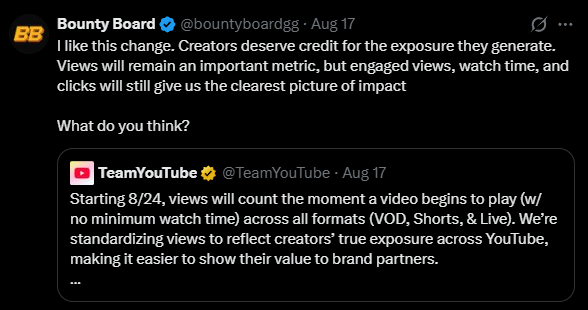
Our take when YouTube announced the change: public views show exposure, while engaged views, watch time, and clicks give sponsors the fuller picture.
What changes the offer
Format, normal performance, audience fit, production time, rights, and reliability all move the price.
For recorded video, compare recent views on games like the one being offered. For Twitch, use normal concurrent viewers, stream length, viewer-hours, and how chat responds to similar games. Twitch's Creator Profile for sponsorship discovery shows the wider context brands can review: channel interests, top categories, selected clips, past sponsors, and audience data.
A 30-second mention, a dedicated ten-minute video, and a two-hour stream are different jobs. Be honest about the research, capture, editing, captions, revisions, and deadline. A smaller tactical-roguelike channel may be a better match for that studio than a larger general-gaming channel, but smaller is not automatically better.
Price ad usage and exclusivity separately. Clear communication, on-time delivery, and useful reporting also reduce the studio's risk. Studios owe creators the same standard with a clear scope, quick answers, and on-time approval. A finished campaign can then become evidence for the next deal.
Cash, commission, keys, and ad revenue are different
Small creators often see offers that combine unlike things.
- Flat fee: Agreed cash for accepted work.
- Performance bonus: Extra cash after a defined result is reached and verified.
- Affiliate commission: Variable income only when tracked actions happen.
- Free game key or product: Access or non-cash compensation, not cash pay.
- Platform revenue: Ads, subscriptions, Bits, or memberships paid under the platform's own rules.
If you cover a game after receiving paid work or a free key, disclose that connection. The FTC's creator guide explains the U.S. standard; other countries and platforms have their own rules.
Impact.com's 2025 global affiliate report surveyed 421 earning creators. Their primary brand-collaboration pay was split across commission, hybrid deals, flat fees, and gifting. The report also notes that commission-based work makes creators carry production cost without guaranteed payment.
Commission can still make sense when the tracking is solid and the audience is likely to act. The creator is taking on more of the risk, though: no tracked result means no pay. A hybrid deal can cover the work with a base fee and add commission when those tracked results come in.
YouTube also confirms that marking a video as paid promotion does not remove it from AdSense. Sponsor pay and platform ad income are separate numbers, even when they come from the same video.
How to judge your next offer
Do this before saying yes:
- Write down every deliverable, deadline, revision, link, and disclosure.
- Estimate the real hours for research, play, capture, editing, publishing, and reporting.
- Set a floor that covers your time and direct costs.
- Compare the offer with normal recent views or live viewers, after removing outliers.
- Separate the gross reward, platform fee, expected cash receipt, and taxes.
- Check usage rights, exclusivity, payment trigger, and payout timing.
- Ask whether the finished work will strengthen your portfolio or lead naturally to repeat work.
A simple floor can start here:
Production hours × your minimum hourly rate + direct costs
That floor is not the final quote. Audience value, rights, and exclusivity can raise it. Calculating the floor makes ten unpaid hours harder to overlook when an offer is framed as “good exposure.”
If you need better-fit opportunities, start with how gaming creators can find paid indie game work. If you want the buyer-side benchmarks and budget factors, read what it costs to hire gaming creators.
A better early goal than chasing one headline rate is a run of paid work you can point to, price more clearly, and build on.
Sources worth reading
Keep going
Looking for better-fit indie work?
Browse live campaigns and find games that make sense for your channel.
Related guides
Creator Opportunities
CreatorsDo playtesters get paid? What game testing pays in 2026
Some playtests pay cash, some pay in a free copy, and Steam Playtest pays nothing. Here is what each kind pays, who can join, and how the money reaches you.
- Published
- October 18, 2026
- Read time
- 6 min read
Creator Opportunities
The gaming creator disclosure guide
Cash counts. A free game key counts too. Here is what to disclose, where to put it, and which platform setting to turn on before you publish.
- Published
- August 19, 2026
- Read time
- 11 min read

Creator Opportunities
How gaming creators can find better-fit indie game opportunities
The best creator opportunities are not always the biggest. They are the ones where your audience, format, and taste fit the game.
- Published
- July 11, 2026
- Read time
- 5 min read